2021-05-18
A look behind the scenes: Chillida’s path to Wiesbaden (part 2)
In part 1 of our look behind the scenes, we provided information about how the sculpture Buscando la luz III (Looking for the light III) by Eduardo Chillida ended up in the hands of the collector Reinhard Ernst. But with his acquisition of the work of art at a Sotheby’s auction in London, the story was far from over. Carolin Langer, the art historian at the future Reinhard Ernst Museum, gives some insight into further developments.
Our investigation got going initially with the good news about the purchase of the Chillida sculpture in multiple parts. What does the object look like, what information is important and what does the haulage contractor have to be notified of?
First of all, of course, the proportions of a work of art have to be known in order to transport it. In the Reinhard Ernst Collection, we are accustomed to dealing with large sizes, as they are one of the collection’s unique features.
Sotheby’s provided us with all the details we required, including the weight of the individual parts of the work. These details alone made it clear that transporting it would be a real challenge. The three sections of the sculpture each weigh between 2,500 and 3,700 kg and are indeed rather large. The art shipping company was suitably stunned when it received all the information. Many other questions arose, such as how the objects were currently stored. Are they standing on pallets? How do we load the objects into the lorry? Where are the sculptures to be transported? Is there enough space there for unloading? Is there a crane available?
For the Reinhard Ernst Museum and the current construction work, another detail was important. Are the weights the auction house forwarded to us correct? Has the ceiling over the basement below been designed for such a load?
According to the original museum plans, a considerably lighter sculpture was to be installed here, which is why a structural engineer’s assessment had to be requested again. He was asked to calculate a steel structure to be produced, which can be inserted before the sculpture is installed.
Then the transport coordination began. The sections of the sculpture were stored on heavy-duty pallets in a London depository. The haulage contractor based in Germany, in collaboration with an associated British company, planned to load it using a heavy-duty forklift, which would lift the three pallets on to the semitrailer’s loading area. As the client, we had no influence on these proceedings.
Following a safety inspection by the haulier with trained depository staff in London and an assessment of the sculpture parts on site, it was clear that loading could not be carried out with a forklift as planned. Instead, a heavy-duty crane would be used to lift the three sections on to the semitrailer. The haulier’s first quote was adjusted accordingly, the order placed and we were glad to have found a timely date for transport and delivery to the collection’s own art depository. Our aim was to transport the sculpture to Germany in 2020 – as Brexit was about to happen on 31 December 2020. No-one knew at that point how and whether an agreement would be reached between the UK and the EU. The loading time in London was set for 9 December 2020, so we went ahead with our plan. With such expensive works, it is particularly important to have cover confirmed by an insurance company. The confirmation arrived quickly and we confidently expected everything to run smoothly.
The scales, which were supposed to check the weight again, arrived a few days before this agreed date. On the morning of 9 December, I received a message that all the companies involved in the transportation process were present and the heavy-duty crane was currently taking up its position.
An hour later, we received a call from the haulier, which I cheerfully answered – I expected our haulier wished to confirm again that everything was going according to plan. But what I heard from them was bad news: “Ms Langer, we have a major problem. The transport has been cancelled. When lifting part of the sculpture, it crashed and it’s damaged.” What a disaster …
Unfortunately, our haulage contractor could not give us any further information, as the loading was carried out by its associated company in London. So, I got in touch with our contact at Sotheby’s, who was in direct contact with the depository staff on site. She was able to tell me more about the incident. As it was lifted, the first pallet collapsed under the weight of the sculpture and fell from a height of several metres on to another part of the sculpture. I feared the worst. When more than 2,500 kg of steel fall on to at least as much weight from a great height – this could not end well.
Reinhard Ernst, who had been so happy about purchasing the sculpture, was informed of the incident immediately and was initially unable to believe these tragic events had happened. The first photos of the damage that reached us the following day did not bode well – with many dents and gouges on the objects themselves. So, what were we to do now?
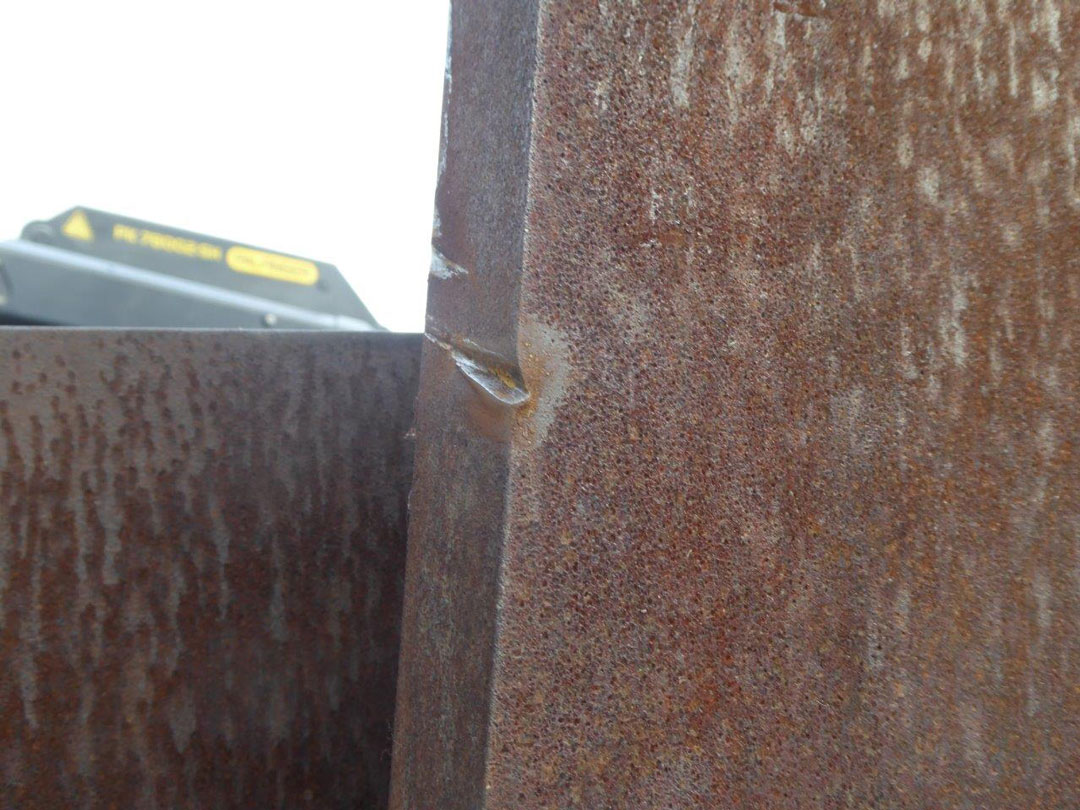
Of course, we first had to notify the insurance. I passed on all the information I had in as much detail as possible. The next step involved the insurance company getting an appraiser to have a close look at the damage, then document and analyse the incident. It was especially important to carry out this assessment on site – which meant the appraiser certainly had to travel to London to review the situation there. But then the next problem was soon on its way: the pandemic situation paralysed the entire world in early 2020 and travel was only possible with restrictions or not at all. In the UK in particular, the infection rate was very high in December and entry was only possible with a huge bureaucratic effort. Thanks to the positive cooperation between our art shipper and the appraiser, a staff member was able to travel to London under strict conditions and produce the appraisal. We also received more detailed photos of the damage. They confirmed once again deep indentations on the sculpture. In addition, one photo showed a long gouge mark across the entire width of one steel surface area. To us it appeared as if the damage was even greater than we had originally assumed.
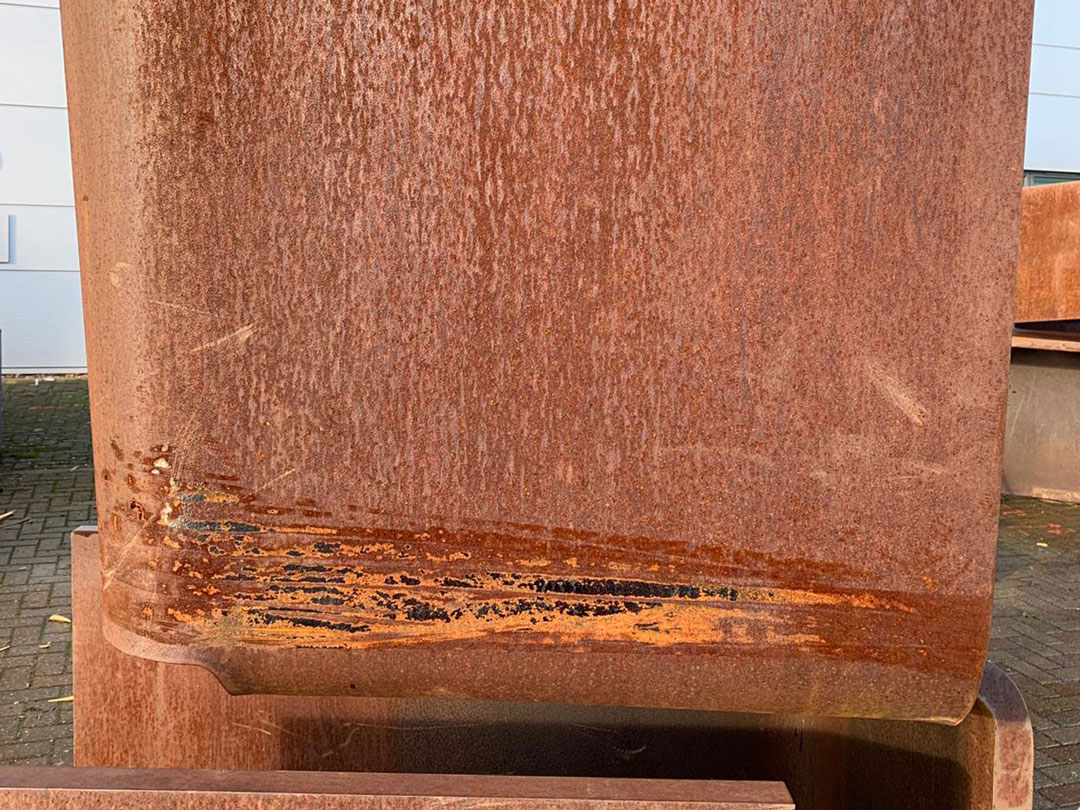
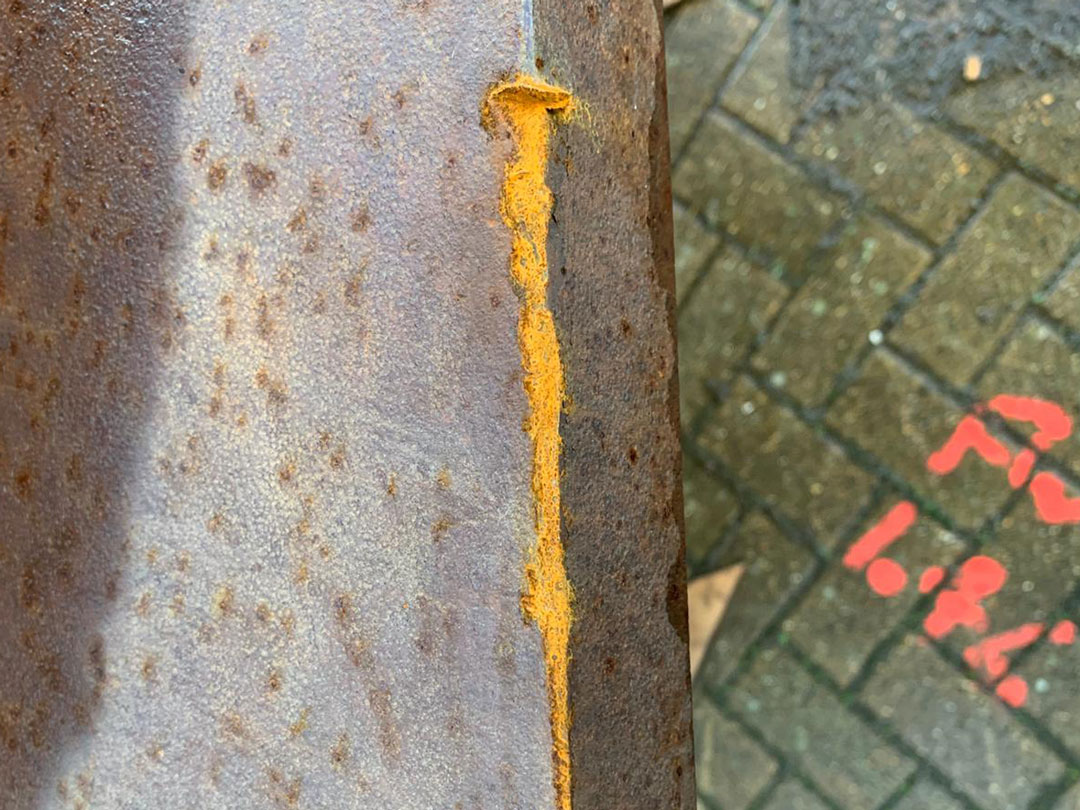
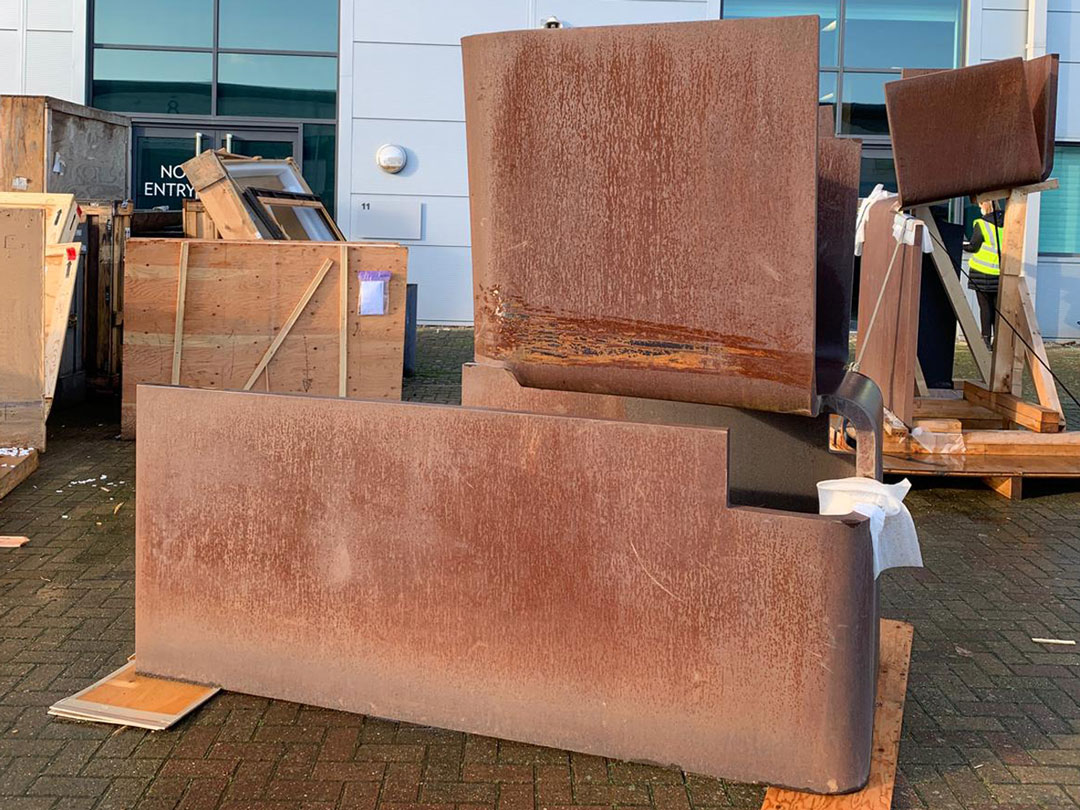
We continued with our deliberations: where should the sculpture be repaired? Should we send it to the Chillida Estate in Spain, should we have it repaired in London, or do we have a good chance of doing so in Germany? Maybe a restorer from the Basque Country would have to travel there to supervise the restoration?
Due to Reinhard Ernst’s friendly contacts with the artist’s sons, the lines of communication were short and the all-clear arrived very soon. The damage was not so severe that it was irreparable. A specialised workshop would be able to help. The appraiser recommended a workshop in Duisburg called Die Schmiede, which has been working with Corten steel for years. It is managed by two experienced and qualified restorers. We took a decision to do the repairs in Germany within a few days. It was now mid-December and Brexit was getting closer and closer. The phone lines of our art shipper company were running hot. New heavy-duty pallets had to be produced and the safe loading of the three sections coordinated. Details of the exact weight of the individual parts was also missing, so that our architects could ensure the load-bearing capacity of the ceiling at the Reinhard Ernst Museum. The Christmas holidays were also just around the corner. Fortunately, we were able to organise everything in such a way that a firm pick-up date was arranged in London for 22 December. Therefore, the sculpture would still get to Germany in 2020 and would be brought straight to the workshop. We would thus avoid all the impending problems associated with Brexit – what a relief!
Of course, this plan did not survive for long. This is because infection rates in the UK got out of control due to a virus mutation. The channel tunnel was closed, and ferry services between Britain and the continent were suspended. France closed its border with Britain. We can all still remember the pictures on the news that showed the lengthy traffic jam going into Dover. This is why our shipment was cancelled and it was now inconceivable that the sculpture would still reach Germany in 2020. Once the spanner’s in the works …
Now we had to wait. As 2021 began, a Brexit agreement was concluded, the borders were reopened and freight traffic between Britain and Europe slowly started up again. So, we made another attempt: a heavy-duty crane, scales and a semitrailer were organised and the new loading date in London was set as 12 January. If everything went according to plan this time, the sculpture would arrive in Duisburg in two days. On 14 January, it happened – the three-part sculpture arrived at the restoration workshop in Duisburg. Reinhard Ernst was there himself to take delivery of his long-awaited work of art after this odyssey.
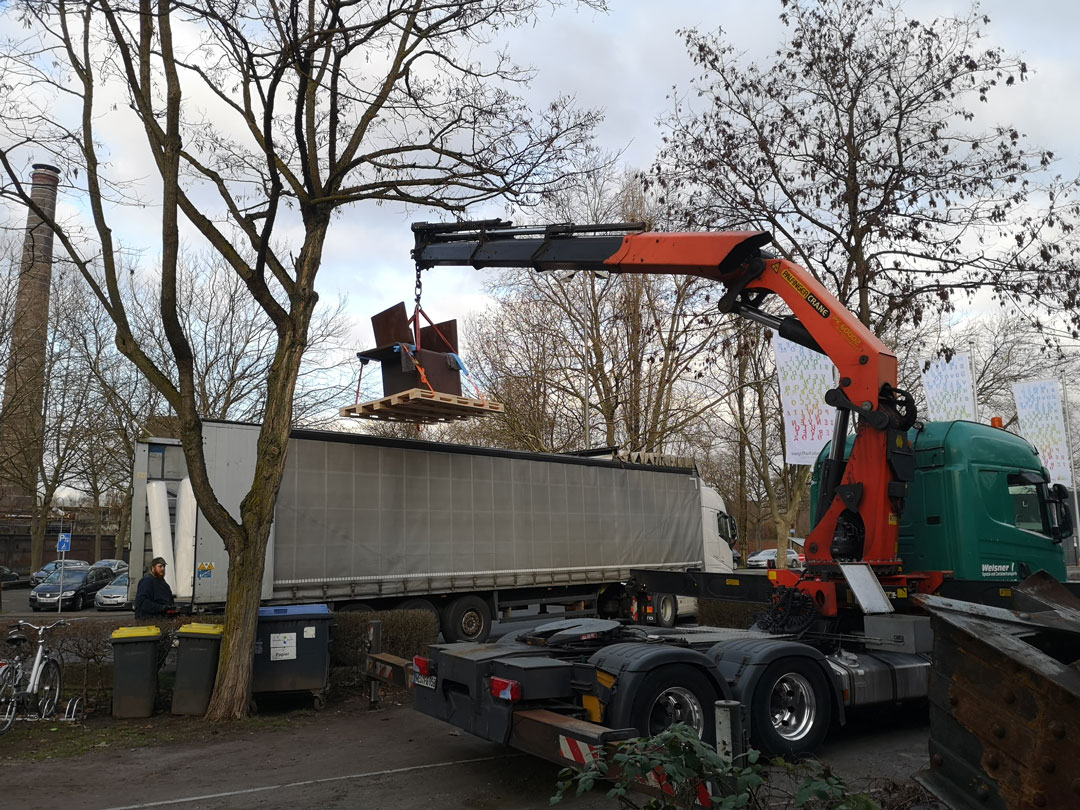
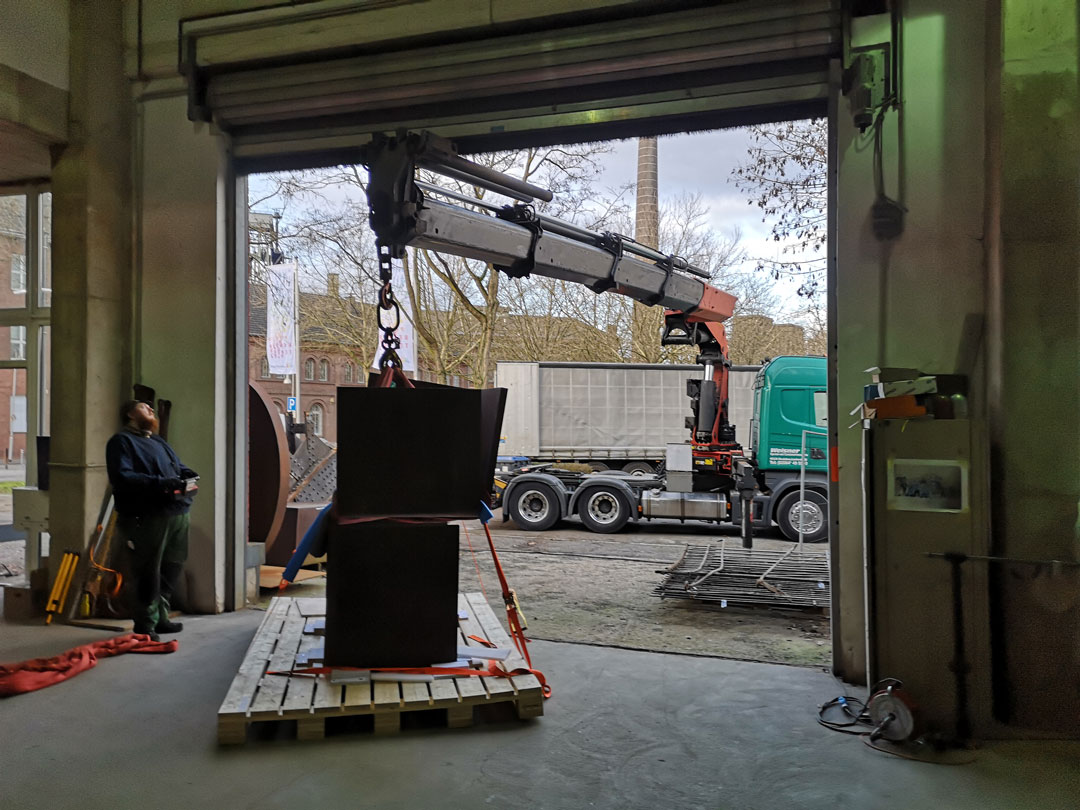

Following an initial assessment by the restorer, the areas could be treated in such a way that the damage will almost disappear. By welding on additional material, with abrasive finishing and applying a special acid, hardly any of the scratches will be visible in two to three years. Corten steel is a very favourable material for repairs like this, as it oxidises over the years. This attribute makes it useful when it comes to restoration.
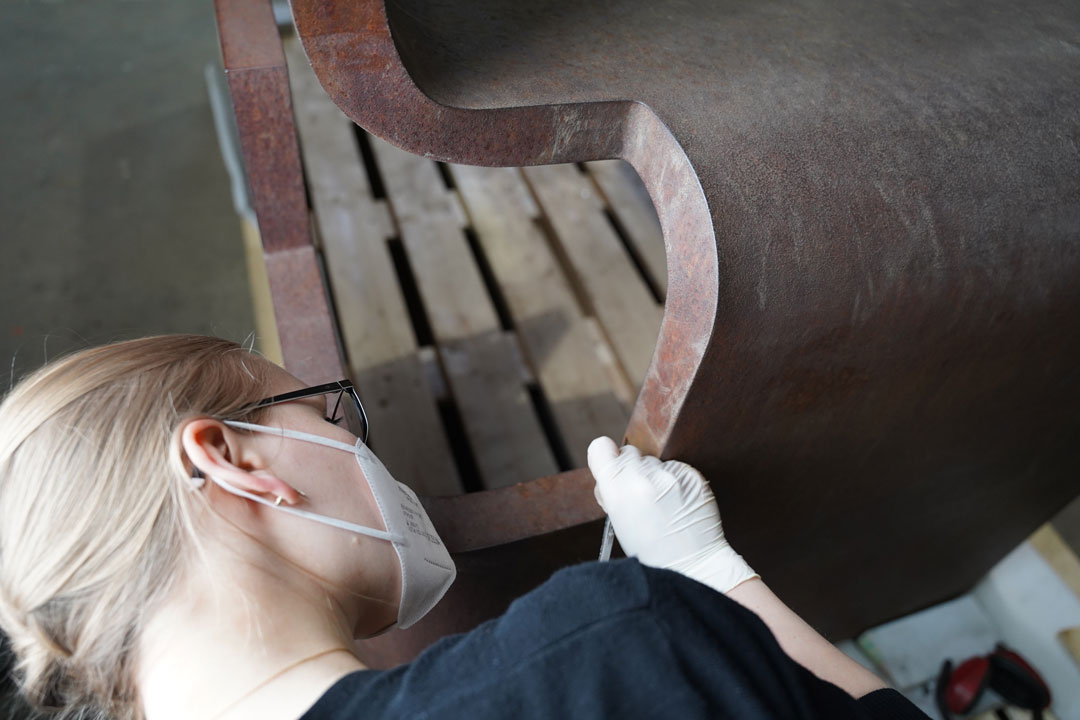
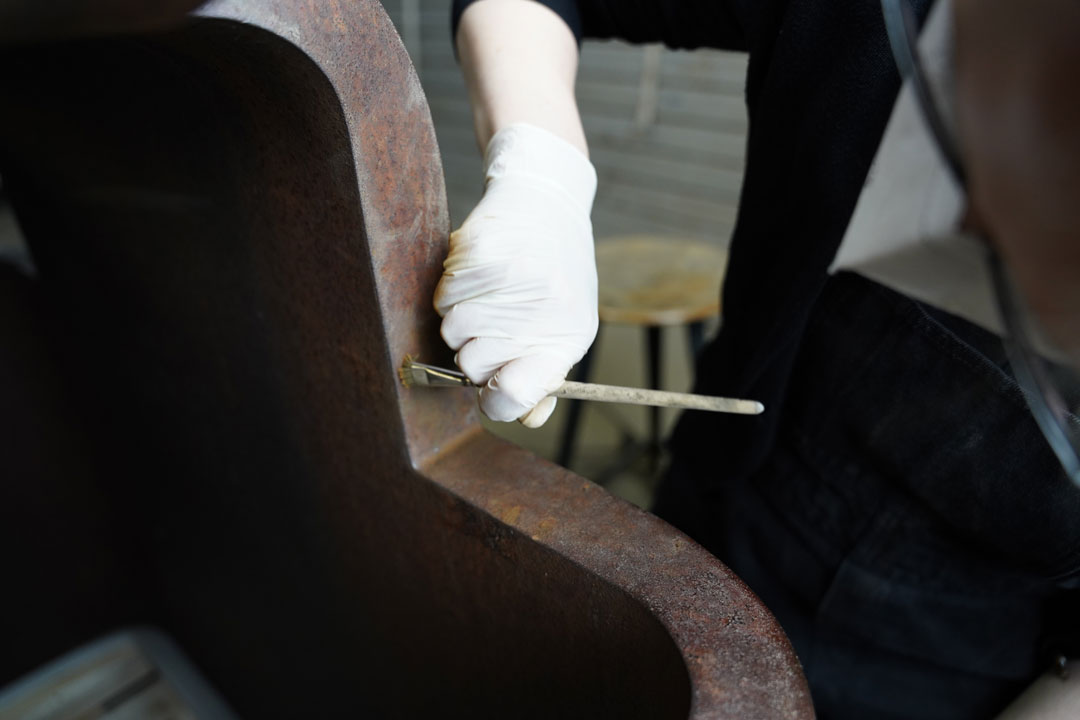
After all the dramatic twists and turns of this story, we could all now breathe a sigh of relief. The insurance company also confirmed it would cover the repair costs. After the work carried out in the workshop in Duisburg, the sculpture will be stored temporarily in our art depository until it finally occupies its permanent place in the atrium of the Reinhard Ernst Museum in 2022.
By then, the museum building will be almost complete. So, there is only one way to transport the work of art to its intended place. A crane will lift the three sections into the atrium from above. Several tons will be balanced in a precisely defined spot at a height of over 20 metres. We will report on this spectacle in detail when it happens. Watch this space …